Lighting Revolution

LEDs illuminate the Timeball in New York City.

LED technology is poised to transform the future of lighting – with huge cost savings for businesses and energy producers. David Killick reports.

New York City, New Year. Thousands of people crowd into Times Square to watch the Timeball plunge down amid a sea of sparkling light, ushering in another year.

In January I found myself along with a bunch of journalists atop the Timeball building, marveling at this unique structure. The Timeball is composed of shimmering Swarowski crystals, and now, for the first time, it’s illuminated by LEDs (Light Emitting Diodes) – to be precise, 32,256 Luxeon LEDS from Philips Lighting, “arrayed in programmable modules.”

The benefits, says Philips, are more precise control, more wide-ranging effects, and 20 per cent more efficiency compared with the previous incandescent lighting.

The nearby Rockefeller Center’s Target Interactive Breezeway is another showpiece. Stand with your back to the wall and LED lights above “lock on” to you, choosing your own special color and following you around the room. Fun for kids of all ages.

Around the world, some impressive buildings are being transformed by Philips LED lighting: Atlantic City’s Harrah’s Casino can be seen miles out to sea; the world’s tallest (610m) TV tower in Guangzhou, China; a landmark bridge in Nanning City, China; the Jawaharlal Nehru Stadium in Delhi, which hosted the Commonwealth Games ceremonies; and closer to home, the Auckland Museum, the Newmarket Train Station, and the Christchurch International Airport Tower.

Buckingham Palace is also now illuminated by LEDs – not only do they keep the royal purse strings tighter, because LEDs are more efficient they don’t keep the occupants awake. HM can sleep easy.

LEDs are finding their way into many smaller places, too, like bathrooms and kitchens. At Philips Color Kinetics showroom in Fifth Avenue, we are treated to displays of rainbow walls, multicolored display cabinets, and a bar area that keeps changing color. Cool.

As glamorous and exciting as this special effects lighting is, it is the cost savings for business that are proving truly transformative, says director of product marketing for Philips Color Kinetics, Brian Bernstein. Consumers will benefit, but businesses will reap the rewards first, he says.

“LED sources are also gaining popularity because they are extremely energy efficient – cutting energy costs by up to 50 per cent, and have a very long life, thus virtually eliminating the sort of maintenance and replacement required by traditional lighting,” says Philips.

Some more figures: LED lights can be five times more energy efficient than incandescent and halogen sources. They can last from 12 to 20 times as long.

That translates to big cost savings for businesses, which no longer have to factor in expensive replacement programs and maintenance schedules or bulbs every year or two.

A few other plus points include no mercury – a much-criticized flaw of “energy-efficient” CFL (compact fluorescent) bulbs, so there are no special handling or disposal requirements. They also have no harmful UV or IR emissions.

Efficiency also has to do with wasted light. Those old incandescents may be ingenious – and they have been around for over a century – but they are woefully wasteful: only around 10 per cent of the energy is used to make visible light. Compare both bulbs and the difference is striking: incandescents generate heat; LEDs remain cool to the touch.

LEDs are more directional, so less light is scattered. This has a big impact on choosing what power light bulb you need. A 100W equivalent? Perhaps a 40W equivalent will be fine, because it is more efficient. Actually, you had better get used to a new measurement: lumens. To choose the best light, you really have to try it yourself.

The US Department of Energy has offered a prize for the first LED replacement for the 60W incandescent bulb. The bulb developed at Philips Lumileds in San Jose, Calif., generates the same output, 900 lumens, is ultra efficient (only 10 watts of power generates 90 lumens per watt), uses 84 per cent less energy, and lasts more than 25,000 hours. It also installs itself and recycles itself automatically. Just kidding.

(By comparison, an incandescent 60W bulb uses the full 60W to generate just 14 lumens per watt, and lasts only 750 to 1,500 hours.)

The Department of Energy is currently evaluating whether the Philips bulb meets all the criteria for the “L-Prize,” but there are no other entrants so far.

With such clear advantages for LED lights, surely it’s a no-brainer. What, then, are the disadvantages? There is only one main one: the technology and production process are complex. Prices have been expensive, but are coming down.

The world’s first commercial LED was developed in 1967. In the 70s LEDs were used in calculators, followed in the 80s, 90s, and 2000s by growing use in car indicators, traffic lights, and TVs – and finally into everyday lights.

LEDs bulbs look much the same as regular bulbs, apart from a ridged cone at their base and a partly concealed yellow tip. Inside, they are radically different. An LED (Light Emitting Diode) is basically a semi-conductor that emits visible light, as opposed to using gas or a filament. Main components are a ceramic layer, thermal pad, cathode, another metal layer, an LED chip, a phosphor layer (to produce white light, a major technical challenge that has now been solved), and a silicone lens.

OLEDs (Organic LEDS) are a new development that is extremely flat, allowing new applications.

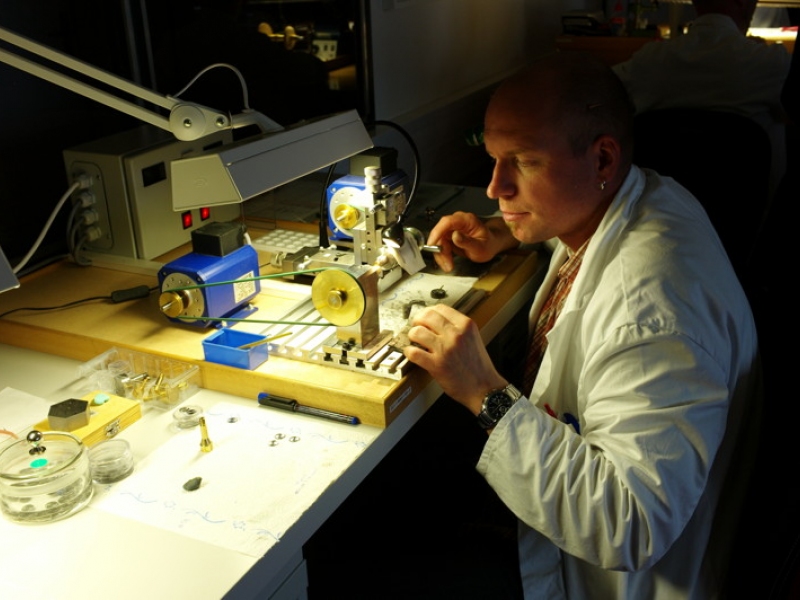
We discover more at the Philips Lumileds in San Jose, where we don full gear – overalls, gloves, boots, headgear and facemasks – for a clean room factory tour. The slightest ingress of dust could harm production. We are rewarded with a view of giant machines with strange waving arms. Engineers insert their own arms and manipulate components. These include rare earth elements, all regulated to the nth degree, right down to the atomic level. Not anyone can do this work. The factory alone is swarming with PhDs; hundreds more are engaged in research.

The San Jose plant produces the substrates on which LEDs are based. The complete bulbs are assembled in Asia and the Netherlands. Factory general manager Sunil Thomas is nervous about showing us some of the machines – they are top secret. Not that he need really worry. We haven’t got a clue how they work. Photography is strictly off limits.

Despite the complexity, the finished product looks refreshingly simple. LED bulbs come in screw mount and bayonet mount fittings, run on 240V or 12V and can plug right in to your existing light fitting.

They are also dimmable, and come in a variety of colors, including warm white (your best bet for indoor use), cool white (more popular in Asian countries), and a rainbow of colors for special effects and displays. Color temperature is measured in degrees Kelvin. “Warm white”' is 2700K. “Cool white”' is 5000K and above. As a reference point, daylight is also 5000K, while a candle flame is about 1900K.

So, if LEDs are the future, what changes can we expect to see? Some countries, such as Australia, have already banned the incandescent light bulb. New Zealand lags behind. The LED replacements for incandescents have the potential to save 34-terrawatt hours of electricity and 5.6 million metric tones of carbon emissions annually in the US alone, Philips says in its submission for the L-Prize. Surprisingly, Philips doesn’t push the carbon emission savings message during our visit. Perhaps that’s because it is message that developing countries – which from a massive part of a growing market – don’t want to focus on too much. In New Zealand, where the bulk of our electricity already comes from environmentally friendly hydropower, carbon emissions savings are irrelevant anyway.

But, whichever way you look at it, the potential for energy and cost savings are staggering. As is the LED lighting market itself.

“Fifty per cent of the market will be LED by 2015,” asserts Nigel D’Acre, the Singapore-based regional business director for Philips Asia Commercial Lighting.

Philips, which is headquartered in the Netherlands, is a huge global company employing more than 118,000 employees in more than 60 countries, with 2009 sales of EUR 23 billion. Lighting is only one of its major divisions (the others being healthcare and consumer electronics). The company is confident LEDs have a bright future.

With urban areas expected to grow exponentially – 75 per cent of the world’s population is expected to be urban by 2050, up from 50% today. That’s plenty of lights to switch on.

Buildings, street lighting, traffic lights, appliances, and your home – expect to see LED lights everywhere, soon. Prices for household bulbs so far are quite steep (more than $40) but are certain to come down.

Matthhijs Glastra, executive vice president for worldwide operations for Philips Lumileds Lighting, says the aim is clear:  to “simply enhance life with light.”